Why Financial Interfaces Need Narratives, Not Just Dashboards
New digital spaces often begin with a rush: rapid growth, big promises, and a lot of experimentation happening at once. Just a few years ago, DeFi came up fast. The momentum was huge, and the excitement more so.
The question now is not whether DeFi can grow — we know it can! — but what kind of growth will hold? Growth that comes and goes in waves, or growth that builds trust, loyalty, and a system people want to stay in.
The Fragility of Liquidity
DeFi (Decentralised Finance) is powerful because it enables many people to pool assets within a shared system. When many users contribute liquidity, the platform can offer things that a single person or a small group cannot.
However, the same thing that creates strength, the shared liquidity, also creates vulnerability. If a big chunk of users withdraw quickly, the pool shrinks. Then trades get worse, yields drop, risk feels higher, and even more people want to leave. It can turn into a fast spiral.
In its essence, DeFi is a collective system. Its health rises with participation, and it suffers when participation becomes short-term or fickle.
The Problem of Mercenary Liquidity
The problem is that most DeFi platforms have been built around quick rewards. If a platform offers a high yield today and another one offers a higher yield tomorrow, it is rational for users to move on. Deposit, collect, leave, repeat. DeFi people even have a name for this: mercenary liquidity. Capital that arrives for the reward and disappears the moment the reward shrinks. It is one of the most discussed structural weaknesses in the space because it turns shared pools into revolving doors.
And there is another layer: DeFi systems are abstract. Value moves through vaults, bridges, pools, and incentives that most people cannot picture. Even experienced users can feel unsure when a single click can be irreversible. Many DeFi interfaces still assume expertise, with dense dashboards, technical language, and fragmented journeys that make the space feel intimidating.
Polygon Labs created Katana Network to tackle both sides of the same problem. The goal was to create an ecosystem that could hold liquidity over time, and an interface that could make that ecosystem legible to real people. For their vision to work, loyalty and legibility had to be designed together.
That’s where we came in. Our job at ROCANI was not simply to explain how Katana works, but to shape an experience that could carry its values in a way users could actually feel.
Designing a World, Not Just an Interface
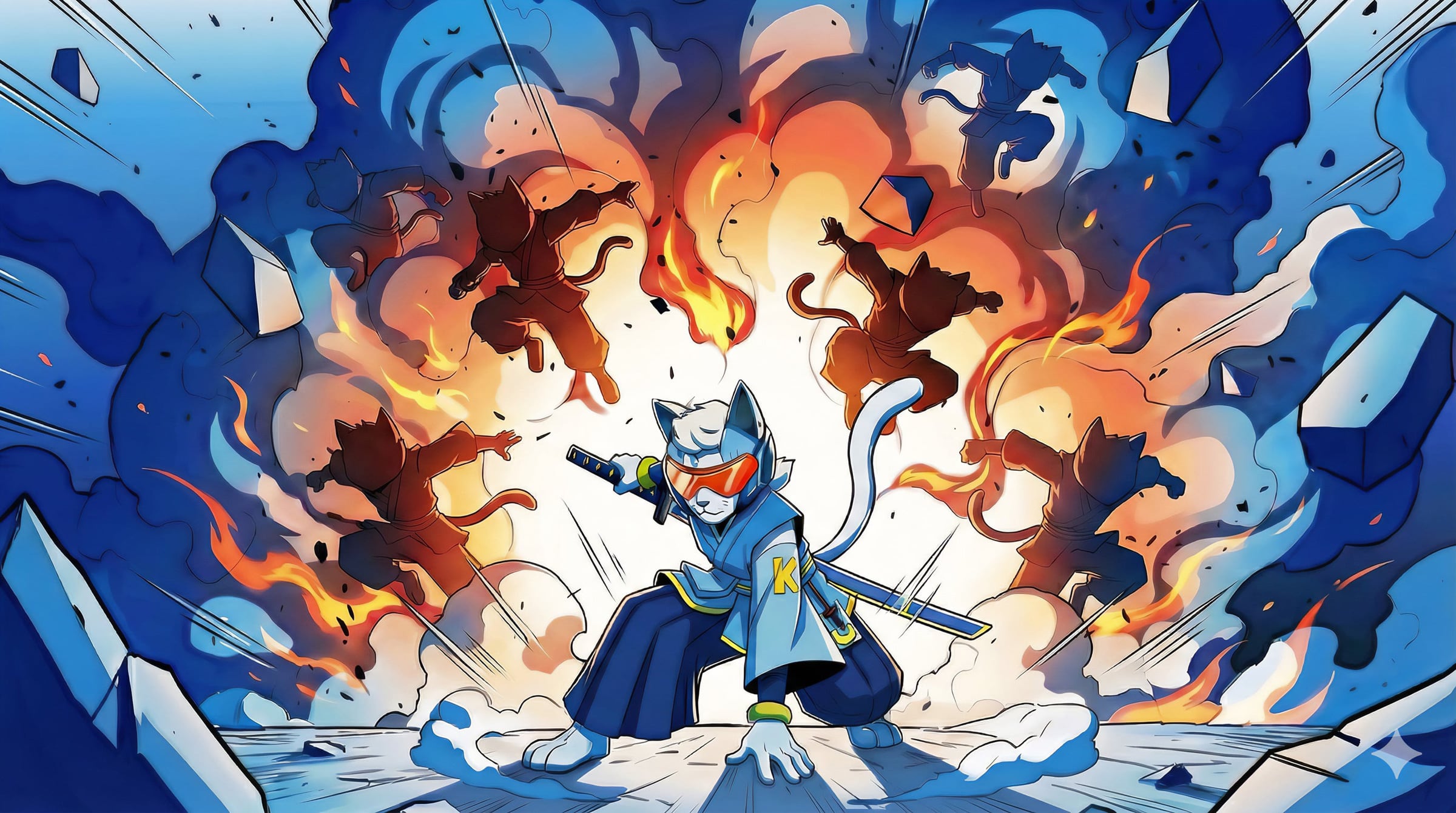
When Polygon brought Katana to us, a Japanese-inspired aesthetic was already part of the vision. What was missing was a way to make that aesthetic do real work. The task was to turn it into a world that helps people understand the system and see themselves inside it. Not a theme for its own sake, but a language for loyalty, cooperation, and shared momentum.
The website is built to unfold rather than present everything at once. As you move through it, the mechanics come into view through motion. Deposits stream into vaults, so the idea of value moving into the system is not just stated; it is shown. Liquidity gathers into a reservoir, a simple metaphor for depth that grows with participation. Yields cycle back through the chain in steady pulses, making the loop feel continuous rather than abstract.
This kind of narrative structure is starting to matter more across financial products. When a system is high stakes and hard to visualise, numbers alone do not create confidence. People need a sense of flow and cause and effect to understand where their actions fit into the whole.
Turning Deposits Into Participation
The pre-deposit phase pushed the idea further. Polygon and Katana did not want depositing to feel like a cold transaction. They wanted it to feel like joining. The Gacha Machine was our answer. Inspired by capsule toys, each deposit unlocked a crate with a real element of chance. Sometimes kat coins, sometimes NFT collectables. It added anticipation to a routine, forgettable step, as most DeFi deposits involve clicking through a wallet prompt, approving the transaction, and waiting for confirmation. No sense of progress, no moment that feels shared. Just a number moved from one place to another.
With the Gacha Machine, depositing became a small ritual belonging to the community, not just to the individual wallet. People compared their pulls, shared them, and kept coming back for another try. Participation became meaningful, and that is the difference between adding a game on top and making play part of why people stay.
If you step back, Katana makes a larger point about where DeFi is heading. The incentives can be engineered, but behaviour is shaped in the experience. Interfaces that treat users like short-term yield hunters will get short-term yield hunters. Interfaces that help people see a system working and feel their role inside it give loyalty a real chance. In that sense, community mechanics are no longer separate from interface design. They are part of what enables these systems to survive.
We return to the same belief we started with. Complex systems only become powerful when people can grasp them. And people grasp them faster when the system is visible, intuitive, and even a little playful. Katana is a strong example of that shift. If loyalty is the weak point, the interface has to be part of the fix.
The early era of digital finance was about proving these systems could exist. The next era is about proving they can last. If the frontier is still being built, then the work is not only engineering new mechanisms. It is designing new ways for users to trust, to understand, and to stay.
More about our approach with Katana Network in our case study.